
Product Research and Profit Analysis Tools: How to Grow Your Online Business
Many online sellers choose products the same way: a hunch, a trending video or a competitor’s best-seller. Sometimes it works. Often the store gets traffic and orders, yet the bank balance barely moves, because nobody checked two questions before buying stock. Will people really buy this? And will I still make money after every cost is paid?
Product research answers the first question and profit analysis answers the second. This guide explains the main product research and profit analysis tools, how to combine them in a simple workflow, and how to use Shopify’s built-in reports to keep your numbers honest.
Why Product Research and Profit Analysis Belong Together
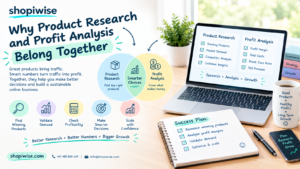
A product with strong demand can still lose money once advertising, shipping and returns are counted. A high-margin product that nobody searches for will not sell at all. You need both signals before you commit.
- Product research shows whether customers want the item and what the market already offers.
- Profit analysis shows whether the sale leaves enough money behind after all costs.
- Together they turn a guess into a decision you can defend.
Types of Product Research Tools and What Each One Tells You
No single tool gives you the full picture. Most sellers combine a few free sources with, if needed, one paid platform.
| Tool type | Examples | Best for | Watch out for |
| Search trend tools | Google Trends, Pinterest Trends | Direction of interest and seasonality | Shows relative interest, not sales or search volume |
| Keyword tools | Google Keyword Planner, SEO tools such as Ahrefs or Semrush | Estimated search demand and ad costs | Estimates differ between tools |
| Competitor research | Rival Shopify stores, Amazon and eBay listings | Prices, positioning and customer complaints | A popular product is not always a profitable one |
| Research platforms | Paid product research apps and browser tools | Generating ideas and spotting ad activity | Treat estimates as leads to verify, not proof |
| Social channels | TikTok, Instagram, Reddit communities | Early trends and real customer problems | Trends can fade quickly |
Step 1: Build a Shortlist of Product Ideas
Start wide, then narrow down. Aim for five to ten candidates rather than falling in love with one.
- Define your niche and customer. Who are you selling to, and what problem are you solving?
- Study competitor best-sellers and new arrivals. Note prices, bundles and how products are presented.
- Read two and three-star reviews. When many buyers repeat the same complaint, that is a clue to a better product or a better offer.
- Listen where customers talk. Niche communities and social platforms often reveal unmet needs before they show up in tools.
Step 2: Validate Demand Before You Commit
Now test each shortlisted idea against real signals.
- Check trends over a long window. Look at a year or more so a short spike is not mistaken for lasting demand. Google notes that Trends data is a relative index and that a spike alone does not mean a topic is popular or winning.
- Estimate search demand. Use a keyword tool to see whether people actively search for the product and what advertisers pay for those searches.
- Check seasonality. Some products sell strongly only at certain times of year, which affects cash flow and stock planning.
- Run a small test. A simple landing page, a pre-order or a short survey of your audience costs far less than a full stock order.
Step 3: Work Out Your Real Profit Before You Buy Stock
Profit per order is what remains after every cost, not just the product cost:
Profit = selling price – product cost – shipping and packaging – payment fees – marketplace or platform fees – advertising – returns and refunds
Here is an illustrative example. These figures are made up to show the method, so replace them with your own.
| Item | Amount per order |
| Selling price | $50.00 |
| Product cost | -$20.00 |
| Shipping and packaging | -$6.00 |
| Payment processing fees | -$2.00 |
| Advertising per order | -$12.00 |
| Returns allowance | -$2.00 |
| Profit per order | $8.00 (16% of the selling price) |
Looking only at the product cost, this item seems to earn $30, a 60% gross margin. After the other costs it earns $8. That gap is exactly why profit analysis matters before you scale advertising.
Step 4: Use Shopify’s Built-In Profit Reports
Shopify can calculate gross profit for you, as long as it knows what each product costs.
- Open a product in your admin and enter the Cost per item in the Pricing section. Do this for every product and variant.
- Go to Analytics > Reports and look for the profit reports, such as Profit by product and Profit by product variant SKU.
- Choose a date range and review cost and gross profit for each item, remembering that discounts and refunds affect your margin.
Know the limits: profit is reported only for products that had a cost recorded when they were sold, and the cost per item is a fixed value, so it does not update automatically when your supplier changes prices. Shopify’s profit reports focus on gross profit, which means costs such as advertising may need tracking in a spreadsheet or a profit analytics app. Report availability can also depend on your plan, so check what you see in your own admin.
Step 5: Track Profit Over Time and Act on It
Profit analysis is a habit, not a one-time calculation. Set a weekly or monthly review and ask a few simple questions:
- Which products leave the most profit after advertising, not just the most revenue?
- Which products fall below your minimum margin and need a new price, a bundle or a cheaper supplier?
- Have supplier costs, shipping rates or ad costs changed since you last updated your cost per item?
- Which test products should be scaled, paused or dropped?
Common Mistakes to Avoid
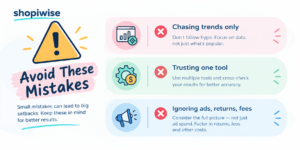
- Chasing trends only. A trending product can have a short life and heavy competition.
- Trusting one tool. Every tool uses estimates, so confirm important signals with a second source.
- Ignoring ads, returns and fees. These costs often decide whether a product is profitable.
- Leaving cost data outdated. Old costs make every report look better or worse than reality.
- Skipping a test. Research reduces risk but does not remove it, so start small.
- Launching too many products at once. It spreads your budget and makes results harder to read.
A Simple Checklist Before You Launch a Product

| Question | What good looks like |
| Is there evidence of demand? | Stable or rising search interest and customers asking for this kind of product |
| Is the margin healthy after all costs? | Profit per order meets the minimum you set, including ads, shipping and returns |
| Is the supplier reliable? | You have tested a sample and confirmed quality and delivery times |
| Do you know the shipping cost? | Shipping and packaging costs are confirmed for your main markets |
| Do you have a test plan? | A clear budget cap and a date to review results |
Frequently Asked Questions
Which product research tool is best?
It depends on your budget and niche. A sensible start is one free trend tool, one keyword tool and a close look at competitors, then a paid research platform only if you need more ideas.
Can Google Trends tell me what will sell?
No. It shows relative search interest on a 0 to 100 scale, not sales or search volume. Use it to check direction and seasonality, then validate with other signals.
Does Shopify show net profit?
Shopify’s profit reports show gross profit based on the cost per item you enter. Other costs such as advertising usually need to be tracked separately.
What profit margin should I aim for?
There is no universal number. It depends on your category, advertising costs and goals. Set a minimum margin after all costs, then adjust it as you learn from real results.
Do I need paid tools to get started?
Not necessarily. Free tools and Shopify’s own reports cover the basics. Paid tools help once you need faster idea generation or deeper tracking.
Conclusion: Grow Your Online Business with Shopiwise
Good products are found by research and proven by profit. Build a shortlist, validate demand with more than one signal, calculate profit after every cost, then review your numbers regularly. That routine protects your budget and shows you where to grow.
If you would rather have experts support you, Shopiwise offers e-commerce account management across Shopify, Amazon, eBay, TikTok Shop and Woo Commerce, and lists winning product research among its services. Learn more about our Shopify services, browse all services, or contact our team to discuss your store at shopiwise.com.