
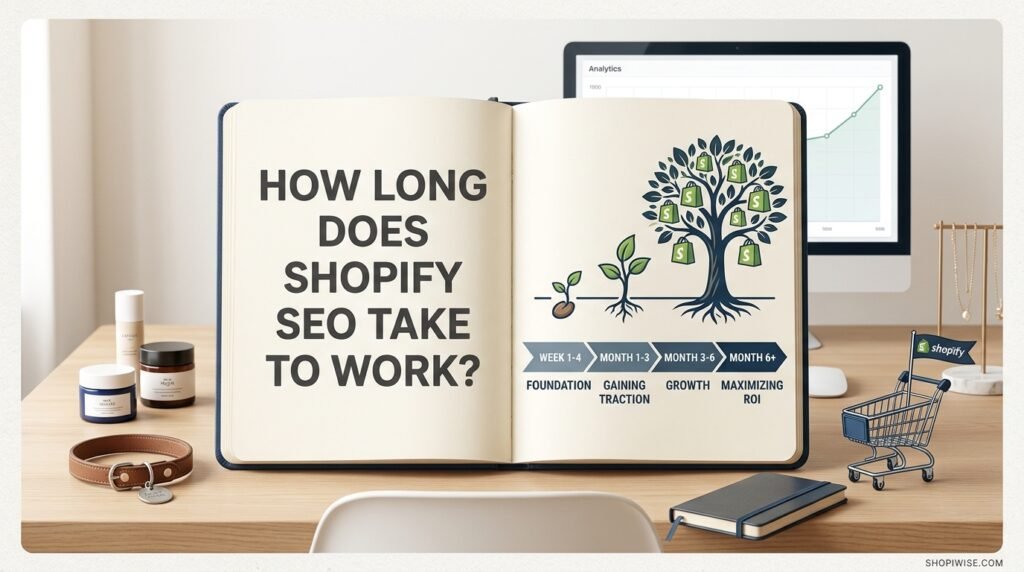
How Long Does Shopify SEO Take?
2
Many stores start to see measurable movement within about three to six months, and competitive niches can take a year or more. One widely cited source quotes a Google presenter saying SEO changes often need four months to a year to show their full benefit. These are typical ranges, not guarantees. Your own timeline depends on competition, your domain history, your content and your technical setup.
A Realistic Shopify SEO Timeline
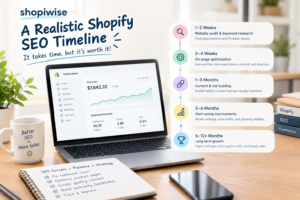
Shopify’s own guidance describes a month-by-month pattern that many ecommerce stores follow. Treat it as a general map, not a promise.
| Period | What usually happens | What you should be doing |
| Months 1-2 | Rankings usually do not move yet | Audit the store, set up tracking, research keywords, fix technical issues and submit your sitemap |
| Month 3 | Impressions may start to rise before rankings do | Optimize product and collection pages, improve titles and descriptions, publish early blog posts |
| Months 4-5 | Rankings begin to shift, often up and down; low-competition terms may reach page one | Keep publishing, build quality links and monitor Search Console |
| Month 6 | Many stores see steadier traffic and early top-10 rankings | Review what works, fix gaps, refresh older content |
| Month 7+ | Gains can compound as the site builds trust and topical authority | Keep improving content and expanding into related topics |
Why Shopify SEO Takes Time
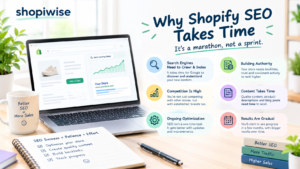
Search engines need to find your pages, understand them and decide whether they deserve to rank. That process is gradual. New or updated pages have to be crawled and indexed, and then they compete against established stores that have had years to build trust and links.
Ranking positions can also bounce around in the early months, especially on a young site. A drop one week does not necessarily mean something is wrong, so avoid reacting to every short-term swing.
What Speeds Up or Slows Down Results
Competition
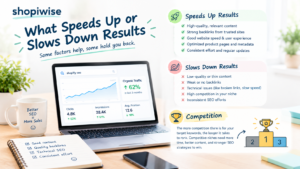
Crowded niches with big brands take longer. Narrower, long-tail searches, such as a specific product type plus a use case, are usually easier to win.
Domain Age and History
A brand-new domain often starts slower than an established one. Stores that previously had spams links or other problems may need extra time to recover.
Content Quality and Consistency
Original, useful product descriptions, collection copy and guides build authority faster than thin or copied text. Steady publishing tends to work better than occasional bursts.
Backlinks
Links from trusted, relevant sites carry more weight than large numbers of low-quality ones. Spammy links can hurt more than help.
Technical Health and User Experience
Slow pages, poor mobile layouts and confusing navigation can limit how well your store performs. Fix indexing blockers, duplicate content issues and accidental noindex settings early.
Strategy and Resources
A clear plan that focuses on the right pages and keywords beats scattered effort. More time or budget can help, but only when it is spent on the right work.
How to Get Shopify SEO Results Faster
- Start with long-tail keywords. Specific searches face less competition and can bring qualified visitors sooner.
- Improve pages that almost rank. Use Google Search Console to find pages sitting around positions four to ten, then strengthen their content, titles and internal links.
- Fix technical blockers. Check that important pages are indexed and that nothing is accidentally hidden from search engines.
- Optimize money pages first. Product and collection pages are closest to a sale, so give them clear titles, helpful descriptions and good images.
- Publish helpful content. Answer real buyer questions in blog posts and link them to relevant products and collections.
- Remove or improve weak pages. Thin or duplicate pages can dilute your store’s overall quality.
How to Tell Whether Your SEO Is Working
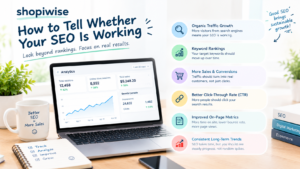
Traffic and sales are lagging indicators. Look for earlier signs of progress first.
- Impressions rising in Google Search Console, even if clicks are low.
- More pages indexed, especially your key product and collection pages.
- Rankings improving for long-tail keywords before head terms.
- Click-through rate improving after you rewrite titles and descriptions.
- Organic visits trending upward over weeks and months, not days.
Compare month against month rather than day against day, and allow for seasonality in your niche.
A Simple Example
Imagine a new Shopify store selling eco-friendly yoga mats. In the first two months the owner fixes technical issues, writes unique product descriptions and submits the sitemap, but sees almost no traffic. By month three, Search Console shows impressions growing for long-tail terms such as “non-slip cork yoga mat”. By month five, a few of those pages reach the first page and begin to attract steady visitors. Competing for “yoga mat” itself would take much longer. This is an illustrative scenario, not a real client result.
Common Mistakes to Avoid
- Expecting results in a few weeks, then abandoning the work too early.
- Chasing broad, highly competitive keywords before winning easier ones.
- Copying manufacturer descriptions instead of writing original product copy.
- Publishing many thin blog posts rather than a few genuinely useful ones.
- Ignoring Search Console and judging progress by sales alone.
- Buying cheap links or trusting anyone who guarantees page-one rankings.
Frequently Asked Questions
Can Shopify SEO work in 30 days?
You may see small signs, such as new pages being indexed or impressions starting to appear, but meaningful ranking and traffic gains usually take longer. Be cautious about anyone promising fast page-one results.
How long does SEO take for a new Shopify store?
New stores often move more slowly because they have little history or authority. Focusing on long-tail keywords and strong product pages gives a new store its best chance of early progress.
Why has my traffic not grown after three months?
Three months can still be early. Check for indexing problems, weak or duplicated content, keyword mismatch and tracking gaps. If these look fine, continue improving and give it more time.
Is SEO or paid advertising faster?
Paid ads can bring traffic as soon as campaigns launch, while SEO builds more slowly but can keep working without paying for every click. Many stores use both.
Do I need to keep doing SEO after I rank?
Yes. Competitors keep publishing and search results change, so refreshing content and monitoring performance helps you hold your position.
Conclusion
Shopify SEO is a long game, but it does not have to feel like guesswork. Fix the technical basics, target realistic keywords, improve your key pages, publish genuinely helpful content and track early signals in Search Console. Results can never be guaranteed, but steady work compounds over time.
If you would like expert help, the team at Shopiwise supports online sellers with digital marketing and SEO-focused services and Shopify store setup and optimization. Contact us to talk about building a plan for your store.
How Long Does Shopify SEO Take to Work?
You have optimized your product pages, written a few blog posts and checked your titles. Weeks later, your traffic has barely moved. It is natural to wonder whether SEO is working at all.
The honest answer is that Shopify SEO takes time, usually months rather than days, and no one can promise an exact date. This guide explains what a realistic timeline looks like, what speeds it up or slows it down, and how to tell whether your efforts are paying off before the traffic arrives.