
Why Your Shopify Ads Are Wasting Money (and How to Stop It)
You are spending every day on ads, but the sales do not match the spend. Reports show clicks and impressions, yet profit is thin or missing. It is easy to blame the platform, but in most accounts the money leaks out through a handful of fixable problems.
This guide covers the most common reasons Shopify ads waste money, including broken tracking, loose targeting, weak landing pages and tired creative, and gives you a practical routine to plug each leak.
Why Do Shopify Ads Waste Money?

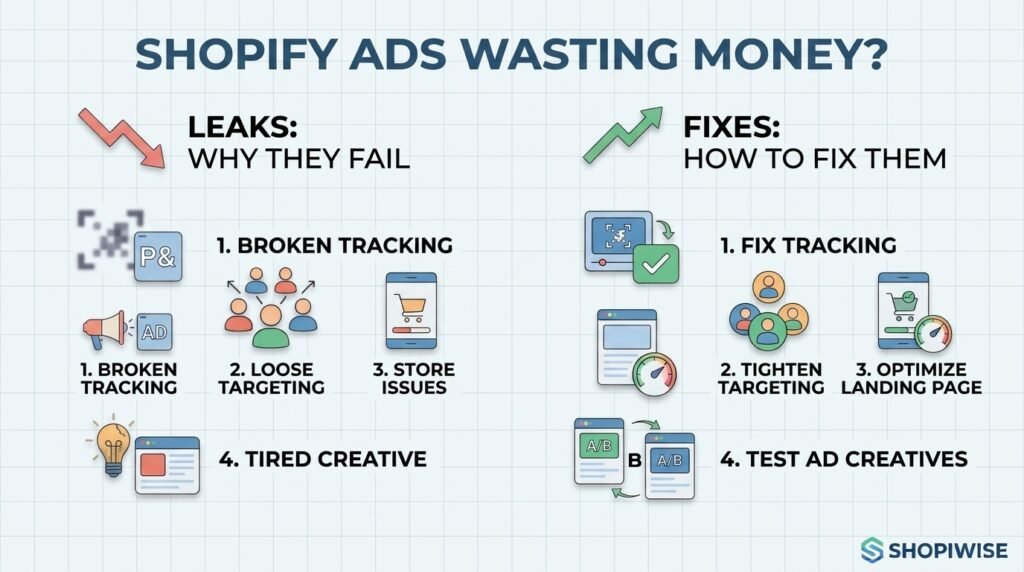
Ad spend is usually wasted when tracking gives the platform poor signals, when targeting is too broad or overlaps, when you keep paying to reach people who already bought, when the campaign is optimized for the wrong action, when the page behind the ad does not convert, or when creative has gone stale. Add loose budget controls and no regular review, and the waste grows quietly.
1. Broken or Incomplete Tracking
Ad platforms learn from the purchase data you send them. If the pixel is misconfigured or misses sales, the system optimizes on a blurry picture and spends accordingly. Shopify’s Facebook & Instagram channel offers data sharing levels, and the Enhanced level adds the Conversions API, which sends purchase data from the server. Compare purchases in your ad account with orders in Shopify. A large gap means fix tracking before changing anything else.
2. Targeting That Is Too Broad or Overlapping
Ads shown to the wrong people cost just as much as ads shown to the right ones. Common leaks include targeting regions you do not ship to, running ad sets whose audiences overlap so they compete against each other, and expanding audiences without any exclusions. Use clear audience groups, check overlap, and build lookalikes from your best customers rather than all visitors.
3. Paying to Reach People Who Already Bought
Recent buyers and people already receiving your email or SMS flows can still see your ads if you do not exclude them. You then pay for impressions that email could have handled more cheaply. Exclude recent purchasers, keep your lists updated and let your owned channels have the first chance with warm contacts. Consider a small holdout test to see how much your ads add on top of email.
4. Optimizing for the Wrong Objective
If a campaign is set to maximize traffic, link clicks or engagement, the platform looks for people who click, not people who buy. Experienced advertiser Jon Loomer has warned that such campaigns often attract visitors who are far less likely to purchase. Where you have enough conversion data, test a sales or purchase objective instead. Boosting posts and chasing likes are other common ways money drains away.
5. Landing Page and Store Problems
Even perfect ads waste money if the page behind them loses visitors. Check that the page matches the ad, loads quickly on mobile, makes shipping and returns clear, and shows genuine reviews and trust signals. Place a test order on your phone to catch checkout friction. Every second of delay and every missing answer costs you paid clicks.
6. Creative Fatigue and Weak Ads
Ads that do not grab attention quickly, rely on generic images or talk only about features tend to underperform, and even strong ads wear out when the same people see them again and again. Watch frequency alongside cost and conversion trends. Test a few clearly different angles, such as the customer problem, a product demo or social proof, instead of many near-identical versions.
7. Messy Structure and Loose Budget Controls
Too many small campaigns split your data and budget into thin slices. Campaigns left running with no conversions keep draining spend. One guide suggests pausing ad sets that produce nothing over about two weeks, and consolidating overlapping campaigns. Use cost caps or targets where they fit, check your placements, and avoid frequent edits that disrupt delivery.
8. Not Knowing Your Break-Even Point
Some ads are not wasted because they fail, but because the numbers never worked. Work out your margin after product cost, shipping, payment fees and returns. Then calculate the cost per purchase you can afford. Without a break-even number, you cannot tell a winning campaign from a slow leak.
How to Stop the Waste: A Weekly Review
- Check tracking. Compare ad account purchases with Shopify orders.
- Review spend by campaign. Find ad sets spending without conversions and pause or fix them.
- Check audiences. Look for overlap and make sure recent buyers are excluded.
- Check frequency and creative. Replace tired ads and test a new angle.
- Test your page. Visit it on mobile and place a test order if anything changed.
- Compare cost per purchase with your break-even. Adjust budgets only after the basics look sound.
When you do raise budgets, one guide suggests increasing by about twenty percent at a time. That is one source’s suggestion, not a rule, so test what suits your account.
A Simple Example
Imagine a store selling pet grooming tools. A weekly review finds that purchases in the ad account are higher than Shopify orders because of duplicated events. Two ad sets also overlap, recent buyers are still being targeted, and the campaign is set to optimize for link clicks. After fixing tracking, excluding buyers, merging the ad sets and testing a purchase objective, the owner can finally see which ads actually earn money. This is an illustrative scenario, not a real client result.
Common Mistakes to Avoid
- Raising the budget before fixing tracking and the store.
- Leaving recent customers in prospecting audiences.
- Optimizing for clicks or likes instead of purchases.
- Running many overlapping campaigns with thin data.
- Letting underperforming ads run for weeks without review.
- Judging success by revenue without knowing your break-even cost per purchase.
Frequently Asked Questions
How do I know if my Shopify ads are wasting money?
Compare your cost per purchase with your break-even point, check for ad sets spending without conversions, and confirm that ad account sales match Shopify orders.
Is it the ads or my store that is the problem?
Check where visitors drop off. If clicks are healthy but add-to-carts and purchases are weak, the store or tracking is a likely culprit. If clicks are weak, look at creative and targeting.
Should I pause ads that are not converting?
Pausing can stop waste, but give each ad set enough time and spend to judge fairly, and diagnose the cause first so you do not repeat the problem.
How often should I review my ads?
A weekly check is a practical routine for many accounts, with a deeper review after any big change. Adjust the rhythm to your spend.
Conclusion
Wasted ad spend rarely comes from one big mistake. It is usually several small leaks working together. Fix tracking, tighten targeting, exclude buyers, choose the right objective, strengthen your pages, refresh creative and review regularly. Results are never guaranteed, but a steady routine keeps more of your budget working for you.
If you would like expert help, the team at Shopiwise supports online sellers with digital marketing and ad campaigns and Shopify store setup and optimization. Contact us to talk about getting more from your ad budget.