
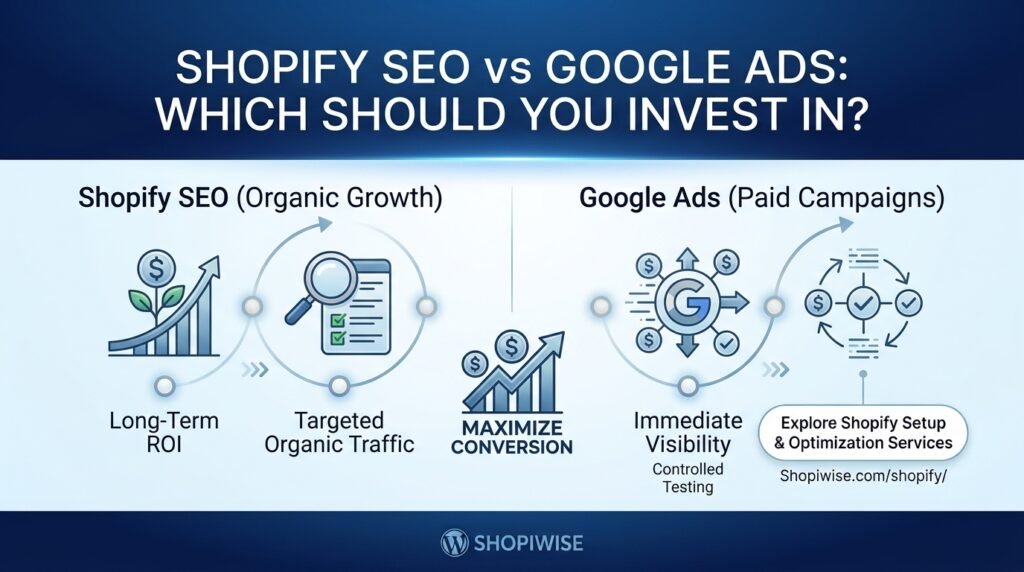
Shopify SEO vs Google Ads — Which Should You Invest In?
If you run a Shopify store, getting the right people to your products is essential. Two common ways to reach shoppers through Google are search engine optimization (SEO) and Google Ads. Both can bring relevant visitors, but they work in different ways and require different kinds of investment.
Shopify SEO focuses on improving your store’s visibility in unpaid search results through useful content, clear site structure, relevant product information, and sound technical foundations. Google Ads lets you pay to show advertising to selected audiences or people searching for particular terms. Paid ads can provide visibility while a campaign is active; organic search visibility is earned and usually requires ongoing work.
So, which should you invest in? The answer depends on your goals, budget, margins, competition, and how quickly you need to learn or attract customers. For many stores, the most practical approach is not “SEO or ads forever,” but choosing the right mix for the stage of the business.
Shopify SEO vs Google Ads: The Main Differences
**Shopify SEO:** Builds your store’s ability to appear in organic search results. It can include keyword research, product and collection page optimization, useful blog content, internal linking, technical improvements, and earning relevant links. You do not pay Google for each organic click, but SEO still requires time, expertise, content, and maintenance.
**Google Ads:** Uses paid campaigns to place ads in eligible Google surfaces. You choose campaign settings, audiences or search themes, bids, budgets, and landing pages. Depending on the campaign and approval process, visibility can begin relatively quickly, but traffic depends on budget, competition, ad relevance, and ongoing management.
Important distinction: paying for Google Ads does not directly improve your organic Google rankings. SEO and advertising can support the same business goals, but they are separate systems.
When Shopify SEO May Be the Right Priority
SEO may deserve more attention when you want to build a durable source of relevant traffic and can invest consistently without expecting immediate results.
- You have product categories with clear search demand and can create genuinely useful, distinct pages for them.
- Your store can benefit from informative content that answers questions before shoppers buy.
- You want to improve product titles, descriptions, collection structure, internal links, and technical foundations.
- You can commit to monitoring and improving pages over time rather than expecting instant ranking changes.
For example, a store selling specialist camping equipment could improve collection pages around real product categories and publish helpful guides on choosing or caring for gear. Those pages may continue to attract visitors while they remain relevant and visible, although rankings and traffic are never guaranteed.
SEO is not free simply because organic clicks do not have a per-click charge. Content creation, technical work, and specialist support can all carry costs. Competitive queries can also take substantial time and effort.
When Google Ads May Be the Right Priority
Google Ads may suit a store that needs to test demand, promote a time-sensitive offer, or gather data about which search terms and products attract qualified visitors.
- You are launching a product and want to test how a defined audience responds.
- You have a seasonal promotion with a clear start and end date.
- You know your product margins and can set a controlled test budget.
- You have conversion tracking and a relevant landing page ready before spending.
For example, a store introducing a new product line might test a focused campaign for a few closely related searches. The campaign can reveal which queries produce engaged visitors or purchases. Results should be assessed against costs and profit—not clicks alone.
Ads are not automatically profitable or instant in every situation. Competition, ad quality, landing-page experience, tracking errors, and the offer itself can all affect performance. Once campaigns stop, paid visibility generally stops too.
Cost, Speed, and Measurement: What to Compare
Instead of relying on generic promises or average costs that may not match your market, compare the channels using your own business numbers.
- Time horizon: Ads can provide early visibility after campaigns are approved; SEO usually takes sustained work and may take months to show meaningful gains.
- Cost structure: Ads spend is tied to campaign activity and clicks or other campaign-specific billing rules. SEO costs often involve people, content, tools, development, and maintenance.
- Control: Ads allow direct changes to budgets, targeting, creative, and campaign settings. SEO changes are made to the website and content, but search visibility is not fully under your control.
- Measurement: Ads can report spend, clicks, conversions, and campaign outcomes when tracking is configured correctly. SEO performance can be monitored through Search Console and analytics, with attention to queries, clicks, landing pages, and business outcomes.
- Durability: Paid visibility depends on continued campaign delivery. Useful organic pages may keep earning visibility, but they require maintenance and can lose rankings or traffic.
A useful ecommerce metric is contribution after acquisition costs. Estimate the revenue and gross margin generated by a campaign, then account for ad spend, discounts, shipping subsidies, returns, and other variable costs. For SEO, measure investment and outcomes over a sensible period and remember that content may contribute across multiple visits or products.
Should You Invest in Both SEO and Google Ads?
Using both can help you cover different stages of growth. Ads can test a commercial message while SEO work improves your store’s long-term discoverability. Insights from one channel can inform the other, but they should be interpreted carefully: paid search terms and organic queries may differ in intent and context.
A practical combined approach:
- Fix the basics first: ensure product pages work well on mobile, prices and shipping details are clear, checkout works, and conversion tracking is reliable.
- Build SEO foundations: organize collections logically, write unique product information, improve titles and descriptions, and create helpful content for relevant customer questions.
- Run a controlled ads test: choose a limited set of products or search themes, set a budget you can afford to learn from, and define what counts as a valuable result.
- Review results together: compare search queries, landing pages, conversions, revenue, margin, and customer quality—not just traffic volume.
- Move budget based on evidence: keep testing, pause wasteful campaigns, and expand SEO pages or ad groups where there is a credible business case.
Common Mistakes to Avoid
- Expecting SEO to produce immediate results or expecting ads to guarantee sales.
- Running ads before checking mobile usability, product information, shipping costs, and checkout.
- Measuring success only by traffic, impressions, or click-through rate.
- Using the same broad keyword list for every product and collection page.
- Making budget decisions using revenue alone while ignoring margin, returns, and acquisition cost.
- Assuming Google Ads spend will raise organic rankings.
Frequently Asked Questions
Is Shopify SEO better than Google Ads?
Neither is universally better. SEO fits longer-term organic visibility goals, while Google Ads can support quicker campaign visibility and controlled testing. The right choice depends on your objectives, resources, product economics, and competition.
How long does Shopify SEO take to work?
There is no guaranteed timeline. Results depend on factors such as site condition, competition, content quality, indexing, and the queries targeted. Track progress over time rather than relying on a fixed promise.
Do Google Ads improve organic rankings?
No. Google states that advertising does not affect a site’s presence or ranking in organic search results. Ads may provide useful campaign data, but that is different from directly improving rankings.
Can a new Shopify store use both?
Yes, if the budget and resources allow it. A new store can build SEO fundamentals while running a small, carefully measured advertising test. If funds are limited, priorities a usable store and reliable measurement before scaling paid campaigns.
How should I decide my marketing budget?
Start with a budget you can afford to test, define a clear objective, and measure sales and margin where possible. Avoid using a universal SEO-versus-ads percentage; costs and results vary by product, country, competition, and business model.
Conclusion: Invest Based on Your Goal, Not the Hype
Shopify SEO and Google Ads solve related but different problems. SEO helps build organic discoverability through relevant pages, useful content, and a strong site experience. Google Ads can help you test demand and reach shoppers through paid campaigns while you fund them. Neither guarantees rankings, traffic quality, or sales.
If you need near-term campaign data, consider a controlled ads test. If you want to strengthen long-term organic visibility, invest in SEO foundations and useful content. If resources allow, combine them and use measured results to guide the next decision.
Shopiwise helps ecommerce businesses with Shopify optimization and digital growth.https://shopiwise.com/https:/ /shopiwise.com/shopify/https:/